


Grammar Without Rules


Discover a simple, visual way to present grammar to students of any level.
The problem – traditional grammar rules, exceptions, and terminology are complex. Students often learn the rules, but because there is so much to remember, they feel overwhelmed and don’t form natural sentences when communicating.
Why? Many expert speakers don’t know “the rules.” We have strong communication skills because:
- we are familiar with the patterns of the language
- we understand what these patterns mean
Becoming familiar takes practice, but grammatical meaning can be elusive. Often, grammar seems to mean different things in different contexts.
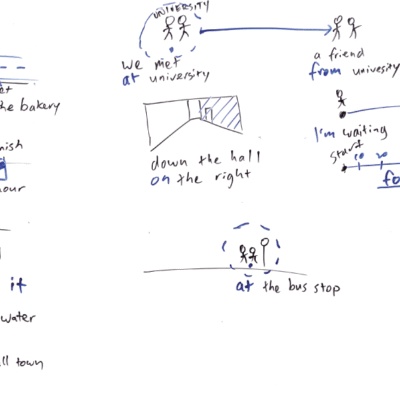
Images cut through the complexity, making it easy to see differences and make connections. English grammar finally makes sense.
Images are simple, yet powerful.
- Fast – can be drawn by anyone in seconds.
- Flexible – apply anytime the grammar is used.
- Connected – help students see how seemingly random uses are related.
Suitable for all levels.
- For beginners: images make it easy to understand meanings of basic grammar that will always hold true.
- For intermediate and advanced learners: images are a powerful tool that helps them understand how one grammar pattern is interpreted differently in different contexts. This helps them understand nuance and make better grammatical choices to communicate with more precision and clarity.
Grammar Without Rules gives you a way to teach grammar that is relatable, deepens understanding, and supports real communication. Students don’t just remember grammar; they use it to understand others and express themselves with confidence.

‘The author brings his experience as a designer to bear on the seemingly intractable task of making grammar ‘friendly’ to both teachers and learners. Starting with phrases, rather than rules, and illustrating these with clear and easily replicable images, he cuts through the accumulation of opaque rules and exceptions that have bedevilled English language teaching for far too long, and offers a spirited, jargon-free alternative.’
-Scott Thornbury, author of How To Teach Grammar
Images. The Difference is Clear.

Is the future fixed? Or are there possibilities?
By comparing images, students see the meaning behind the grammar.
- A simple straight line for a fixed/scheduled future (“We have a class next week.”)
- A fork in the road when there are options or possibilities (“I’ll do it.”)

Straight answers to questions
Students often wonder about the difference between will and going to. It depends on how we view the situation. Are we:
- At a crossroads (e.g., deciding) “I’ll do it.”
- Not thinking about other options or possibilities. We expect it to happen and are simply moving through time until it does (e.g., a plan) “I’m going to do it.”

Covering all uses
The past form (often with -ed) is used for the past, but that’s not all.
- The past
- Imaginary situations
- Politeness
Images are a straightforward way to help students see how these seemingly random uses actually make sense.
Available on: