


Grammar Practice: From Broken English to Natural Sentences
Last week, one of my university students came and spoke with me after class. She loves movies, and said that through doing this activity, she felt she understood more English in movies.
This activity is different from many activities I find in textbooks. Instead of passively getting used to English, students actively focus on what grammar to expect.
We have been doing this practice for around six weeks (part of a class, once a week). Yet, it is already making an impact.
The students in this class are currently second-year university students. They have been studying English through their schooling and although they have studied grammar and listening before, their skills are still lacking. This activity seems to be getting them on the right track.
The activity: simple yet powerful
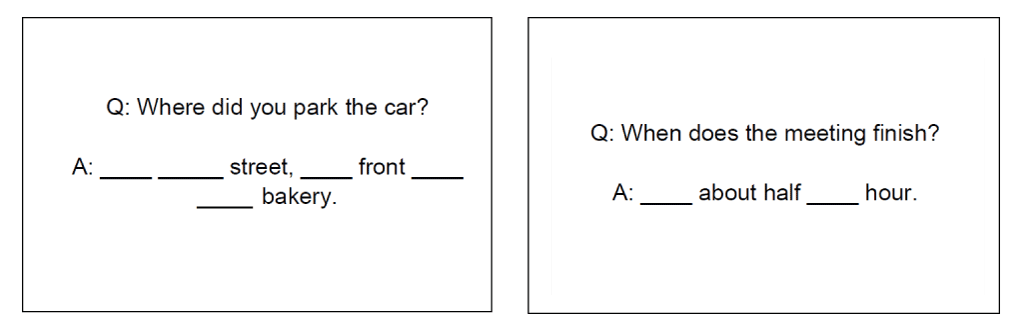
The activity is as simple as taking a text in English, in this case short questions and answers, and removing the grammar.
Like this:
Familiarity
This practice helps students develop a sense of what words go where. This works because it reflects what we do when communicating in real life.
Expert speakers are very familiar with English and predict the words coming next.
Through this practice students become familiar with common phrases and patterns of English that are necessary for them to become fluent speakers.
Meaning and Pictures
Being familiar is one thing, but it makes an even bigger impact when it’s meaningful.
When students are stuck, and don’t know which word fills the gap, they are often unaware of the kind of information an English speaker is expecting. As a teacher, you can guide and support them to help them think more like an English speaker.
The following strategies are useful in this activity, and when giving feedback in general.
I start by saying the kind of information that is needed: who, what, where, etc. When they don’t know the exact meaning that needs to be conveyed, an illustration can clear things up.
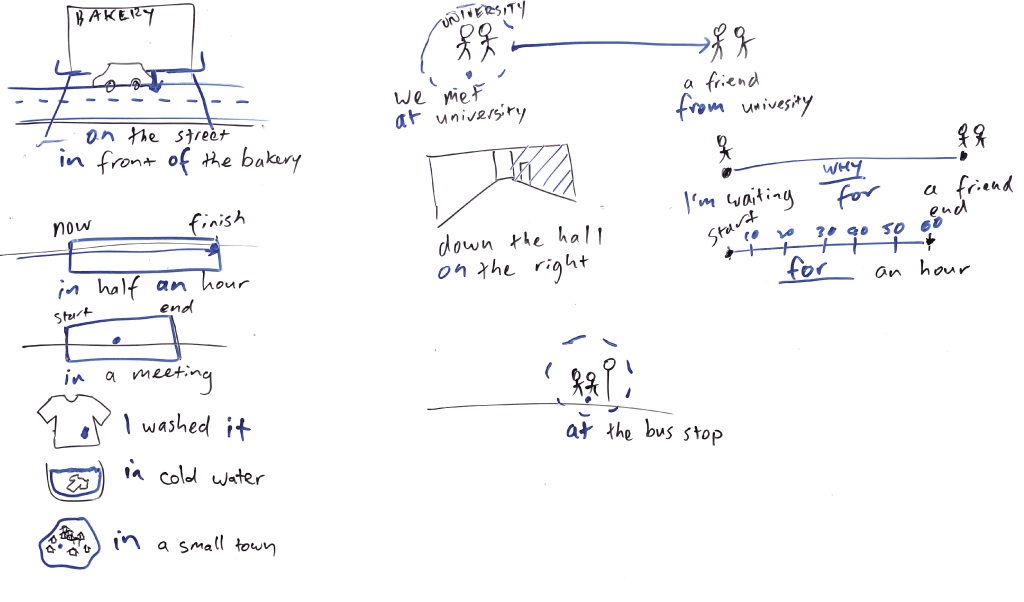
As students continue studying, they see patterns in the words and also patterns in the images. They develop there sense of what words like ‘in’, ‘at’, and ‘for’ mean.
I’ve written more about using images like this to help students understand grammatical meaning in the book Grammar Without Rules: The Visual Method Students Actually Enjoy.
Why studying grammar improves listening skills
When listening to English it’s very hard for students to catch high-frequency grammatical words (I, you, it, the, in, at, etc.). These words are often not articulated clearly because they don’t have to be. Moreover, the student’s first language may not have equivalents for these words so the fact that English has them often seems mysterious, and using them does not come naturally.
On the other hand, an expert listener expects these words, so even a hint of the sound is enough for us to process it.
And not pronouncing these words clearly actually makes communication smoother! Because these words are subtle, by contrast, the vocabulary that is less predictable and carries meaning stands out.
Students will hear people speaking fast and not every word will be clear. This is a beautiful thing about English. It’s light and shade. And it’s something students will need to get used to in order to speak fluently. However, many students can’t hear it.
This is largely due to the fact that they struggle to predict what is coming next.
When we do listening activities with students, it’s natural to just ask them to keep listening until they get it. But when they don’t get it, they may think it’s impossible, which is extremely demotivating. Instead, you can help them through an activity that is achievable and builds the underlying skill that makes listening easier. When listening, expecting the words coming makes it much easier to catch them.
Grammar Practice to Improve Speaking Skills
When we learn a language, we mimic what we hear. It’s no surprise that students who can’t hear natural English, have difficulty speaking it.
Traditional grammar rules try to solve this by giving students a step-by-step process to form sentences. But this doesn’t reflect the thought processes expert speakers use when communicating in real life. (Many expert speakers don’t know the rules!)
We know the patterns. We know the meaning. We unconsciously predict.
Through practice, students strengthen their ability to do this.
The way it works in the activity I’ve described above strikes a balance. Students actively produce sentences using all necessary grammar, in context, with support.
Focused attention on the patterns of English with the support of a teacher can help students develop their sense of how English works while bypassing a lot of the guesswork that comes with just listening and figuring it out for themselves.
Once students can hear and process English, this familiarity with patterns is exactly what they need when forming their own sentences.
When speaking, they unconsciously predict the words they will need next, and the language flows.
This awareness is key. Mastering grammar is not about mastering the points. It’s about being aware of the patterns and which words fit. This skill that all expert speakers have enables us to listen and speak with ease.
“Real Grammar” is about developing this sense, which is a combination of being familiar with the patterns and understanding the underlying meaning, and how it comes together for clear communication.
Teaching or Self-Study
I’ve written this with the teacher in mind but this method also works well for self-study.
For beginners, start with basic sentences and become familiar with the patterns. Write the sentences you want to be able to say, then write them again with gaps for the grammar. Put them aside, and come back later and see if you have the grammar to fill the gaps. Keep practicing until the words flow naturally and keep including more and more sentences.
If you’re an intermediate student and you want to better understand the grammatical meaning and how it all fits, check out Real Grammar: Understand English. Clear and Simple.
For teachers (of all levels) and advanced students who want a deeper understanding, check out Grammar Without Rules: The Visual Method Students Actually Enjoy.
Feel Free to Get in Touch
If you find this useful or have any questions or comments, feel free to contact me here.